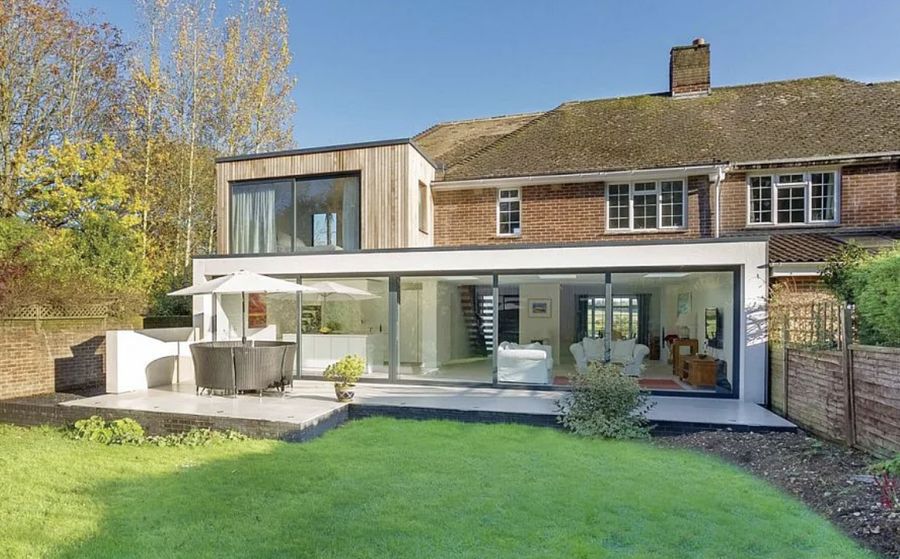
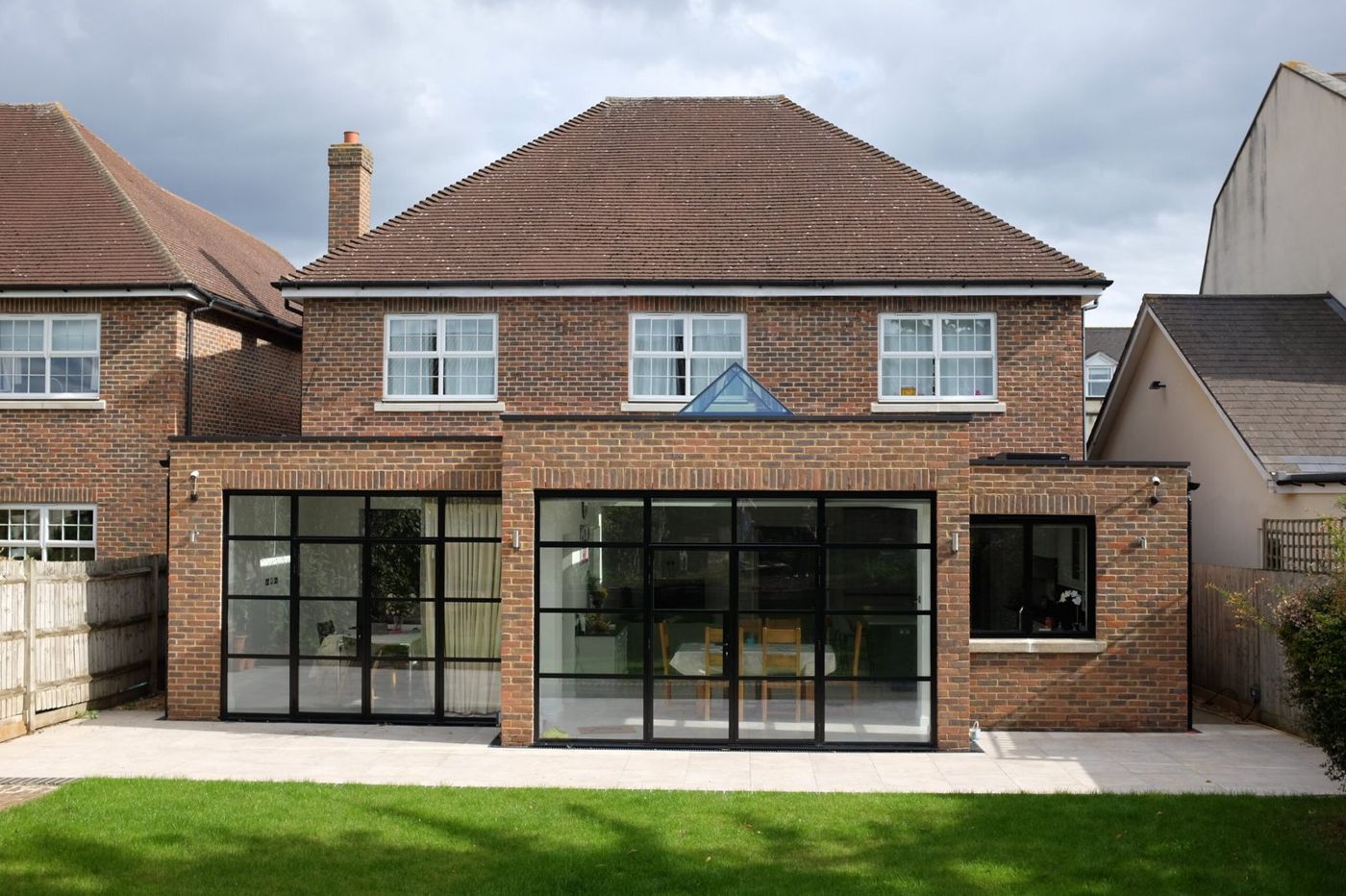
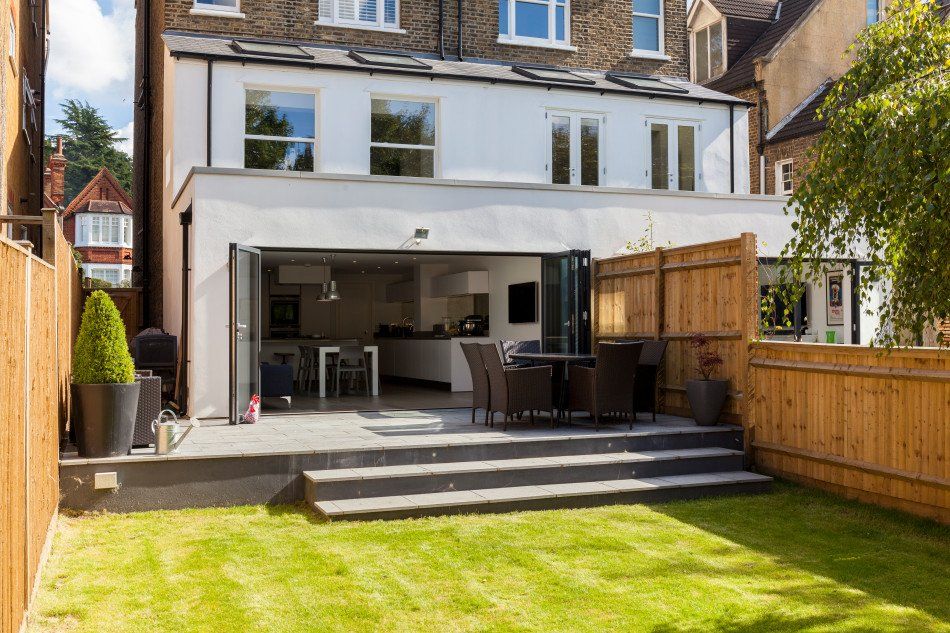
Similar headline price per square metre — but modular finishes in 8–10 weeks instead of 5–9 months, for one fixed price, with no cranes. Here's the honest side-by-side.
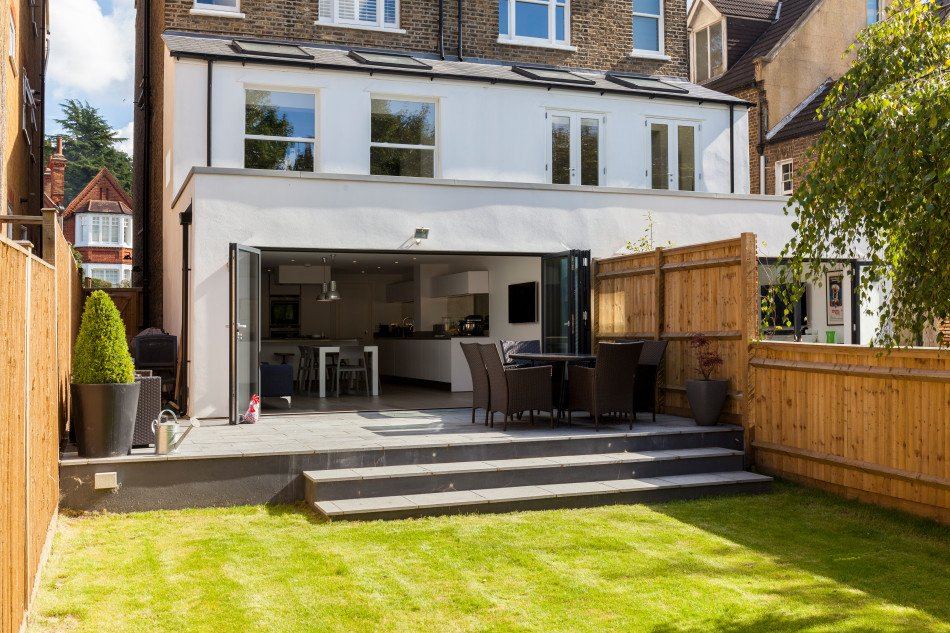
A traditional extension is built brick by brick on site, coordinated across a sequence of trades — bricklayers, roofers, plasterers, electricians, plumbers, decorators — over three to six months. Every stage depends on the last completing, subject to each trade's availability, and every one is exposed to the weather. And because each trade is engaged separately, there is no single source of responsibility or liability if something goes wrong — problems can fall into the gaps between trades, with no one party accountable for the result.
A modular extension is different. The steel frame is manufactured off-site in Coventry and the panels — walls, roof sections, insulation — are made in the factory. On installation day they arrive on a standard flatbed lorry and are hand-assembled over 4–6 weeks by a small in-house team. No cranes. No heavy plant. No trade-coordination gap. And because the whole build sits under one JCT contract with Vita Modular, there is a single, clear source of responsibility and liability from design through to handover — one party accountable for the result. The rest of the comparison flows from that.
One clarification worth making: Vita Modular's is a hybrid, panelised system — not the fully volumetric, craned-in kind some companies offer. That deliberate design bridges Modern Methods of Construction and traditional building: the factory precision, speed and quality control of MMC, with the on-site adaptability and site access of a traditional build. It's what lets us build tight, awkward and period sites that crane-lifted modular can't reach.
In one line. Similar headline £/m². Modular gives you one fixed shell price under a JCT contract and finishes in 8–10 weeks instead of 5–9 months — with no cranes, so tight sites are viable.
On headline per-m² cost, modular and traditional look similar — both sit in the £2,200–£3,500 range for typical single-storey work. The meaningful difference is what the number covers and how certain it is.
Vita Modular's rate is a single fixed price for the complete shell: structure, installation, render, roof, glazing up to 3m, electrics, flooring and decoration, under one JCT contract with a 10-year structural warranty. Ground-floor and single-storey work is ~£3,000/m²; a first floor added above is ~£2,750/m² and already includes the pitched roof and scaffolding those upper storeys need. Items that vary by project — kitchens, bathrooms, demolition, ground preparation, structural openings into the existing house, and professional fees — are quoted separately at fixed prices, so you see each cost explicitly.
A traditional extension quoted at £2,500/m² — and that figure is often the minimum headline price, the starting point before the quote grows — typically excludes most of the envelope trades. Homeowners then commission a decorator, an electrician, a plumber and a glazing supplier separately, and traditional builds frequently run 10–25% over the initial quote once variation orders compound. Similar headline £/m²; very different certainty.
| Stage | Modular (Vita Modular) | Traditional |
|---|---|---|
| Design & planning | Build to your approved drawings, or we produce & manage the application; we complete building-control drawings | Separate architect (4–8 wks) then planning (8–12 wks) |
| Lead time to start | 4 weeks from order | 8–16 weeks after planning |
| Site access | Panelised — no cranes, no plant | Deliveries, skips, plant, sometimes road closures |
| Time on site | 4–6 weeks | 3–6 months |
| Total (order → complete) | 8–10 weeks | 5–9 months |
| Speed vs traditional | ≈70% faster | Baseline |
The 4-week lead time runs from contract signing; groundworks and off-site manufacture happen concurrently, so foundations are ready when the panels arrive.

This is where the comparison diverges most decisively. Because the system is panelised and hand-assembled, it needs no crane and no heavy plant. Victorian side returns, terraced properties with narrow rear alleys, village plots with no rear access and homes with mature garden trees are all buildable — sites every crane-lifted modular competitor is excluded from. For urban homeowners in London, Birmingham, Manchester and Bristol, this is often the decisive factor: not speed, not cost, but whether the extension is physically possible at all.
It also means site access does not affect the price. Because there's no crane hire, no road closures and no heavy plant to bring in, a tight or awkward site is built at the same per-m² rate as an open one — there's no access surcharge.
A traditional extension means daily tradespeople, dust through the house, scaffolding, skips and the extended space unusable for two to four months. A modular extension inverts most of it: the most disruptive phases — cutting, structure, envelope, insulation — happen in the Coventry factory, not your home. What arrives on site are finished panels to be assembled, so there is considerably less mess, dust and noise than a conventional wet-trade build, and far less of it reaches the inside of your house.
On-site activity is compressed into 4–6 weeks in a predictable single-team sequence, with no prolonged period of open brickwork, plastering or drying-out. For families with young children, elderly relatives or anyone working from home, that reduction in daily disruption is often the difference that makes the whole project feel manageable.
Factory manufacturing gives structural quality a consistency on-site building cannot match — no rain-damaged insulation, no cold-weather concrete pours, every steel frame fabricated and every panel inspected in controlled conditions. Traditional quality is only as good as the site team on the day, in the weather they're working in.
Every Vita Modular build meets — and in most cases exceeds — each of the performance criteria set out in the current Building Regulations, from thermal performance and airtightness to structural loading and fire safety. Because the panels are engineered and tested to a consistent factory specification rather than assembled from separate site-bought components, the finished building performs to standard reliably, not just on paper. Vita's warranty — 10-year structural, plus 2-year glazing, electrics and finishes — is longer and more comprehensive than most traditional builder warranties.

A common assumption is that a modular system can't satisfy conservation-area or period-property requirements. Not so. Vita Modular can match effectively any external finish — including the specific materials a conservation area or planning condition requires — from brick slip and timber to render and composite cladding. The steel frame and panels sit behind a façade specified to comply with local planning, so a modular build is a viable route on sensitive and period sites, not just contemporary ones.
Planning requirements depend on the size, position and use of the extension — not the construction method. Many extensions of both types qualify as permitted development.
Where planning permission is needed, you have two options. If you already have approved drawings from your own architect, Vita Modular builds exactly to your pre-approved planning drawings — we work to them directly, and there's no need to use our designers for the application.
Alternatively, we can produce and manage your planning application for you where one is required. Handling it through Vita often works out more cost-effective than instructing an architect separately, and keeps the design, application and build with a single team from the outset.
Either way, what our design team completes is the technical building-control drawings — the detailed construction and structural information the build itself is made from. Those are prepared by our designers as part of the project. Architectural, planning and building-control fees are quoted separately, at fixed prices, and can be selected in the quotation generator alongside any other optional works.
The per-m² shell rate is deliberately clean — the items that vary most from project to project are quoted separately, at fixed prices, so you only pay for what your build actually needs. These can be added and priced in the quotation generator:
Choose modular if: you want cost and timeline certainty; your site has restricted access; you need a fixed completion date; you value a single contract and warranty; you want a precision-manufactured finish; or you're in a conservation area and need matched materials delivered faster and more predictably than a traditional build allows.
Modular does more than people expect: two things often assumed to rule it out don't. Complex, hand-laid brickwork detailing? Vita can do that — the panelised frame sits behind a façade finished to whatever the design or planning condition requires, including intricate brickwork and period detailing. Want to change the specification as you go? That's fine too — specification changes can be accommodated with Vita, and because they're captured and priced clearly rather than emerging as ad-hoc site variations, you keep the cost certainty as well as the flexibility.
For most homeowners adding a rear extension, kitchen addition or open-plan family space — including on conservation-area and period properties, and including projects that need bespoke brickwork or design changes along the way — modular delivers a better result, considerably faster, at comparable total cost, with less disruption and less overrun risk. A traditional build may still suit a project that is genuinely one-off from top to bottom, but for the great majority of extensions, modular is the stronger route.