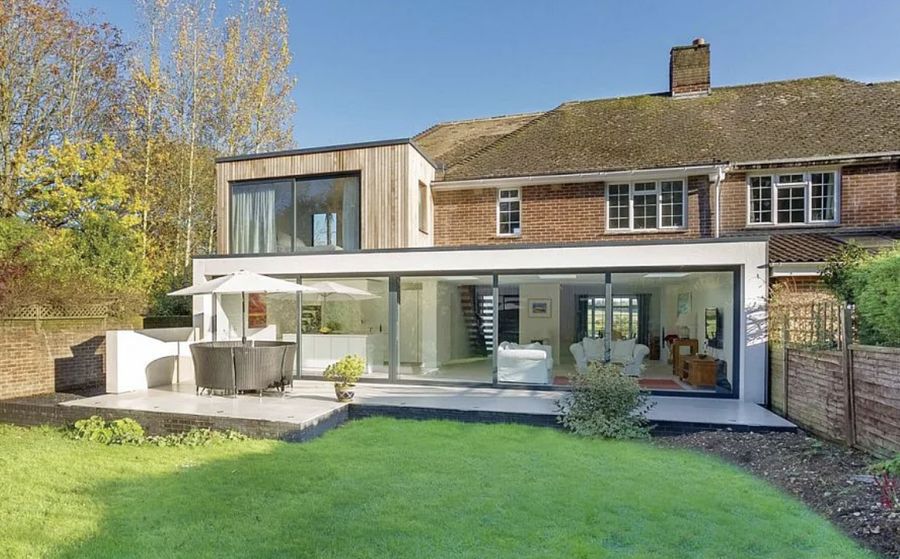
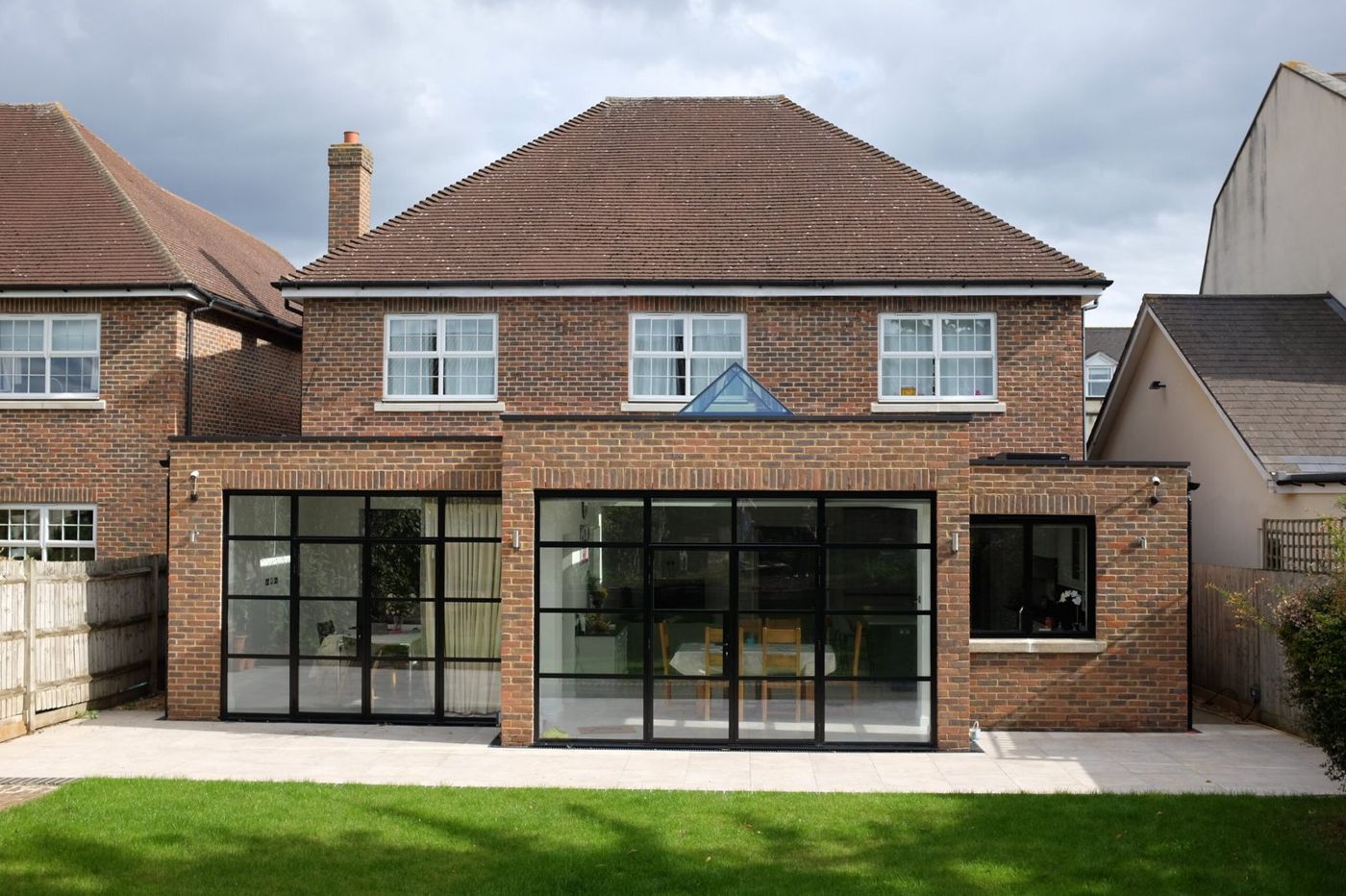
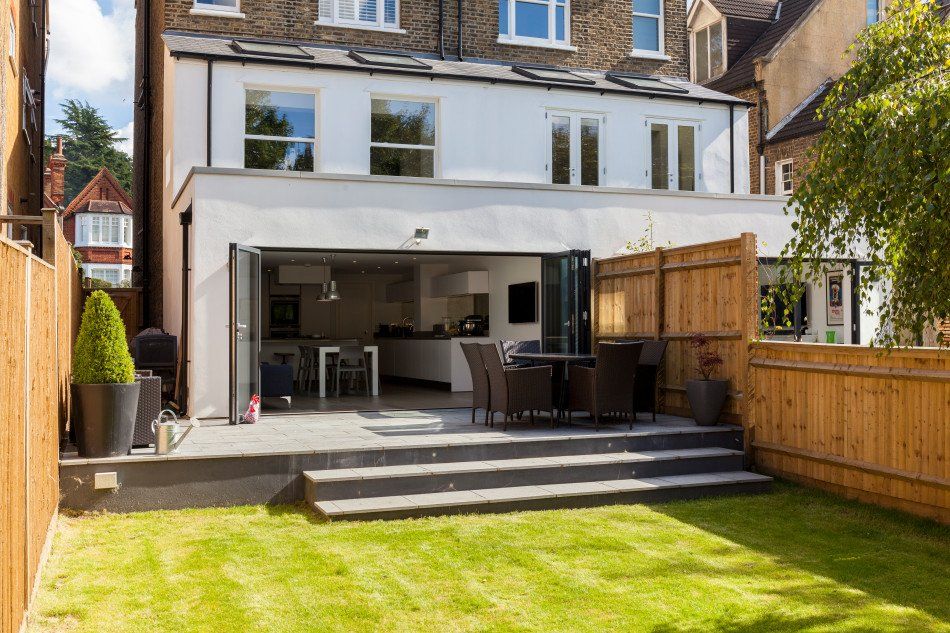
A modular extension is a house extension where the frame and panels are made in a factory, then hand-assembled on site — no cranes required. Here's how they work, what they cost, and whether they need planning.
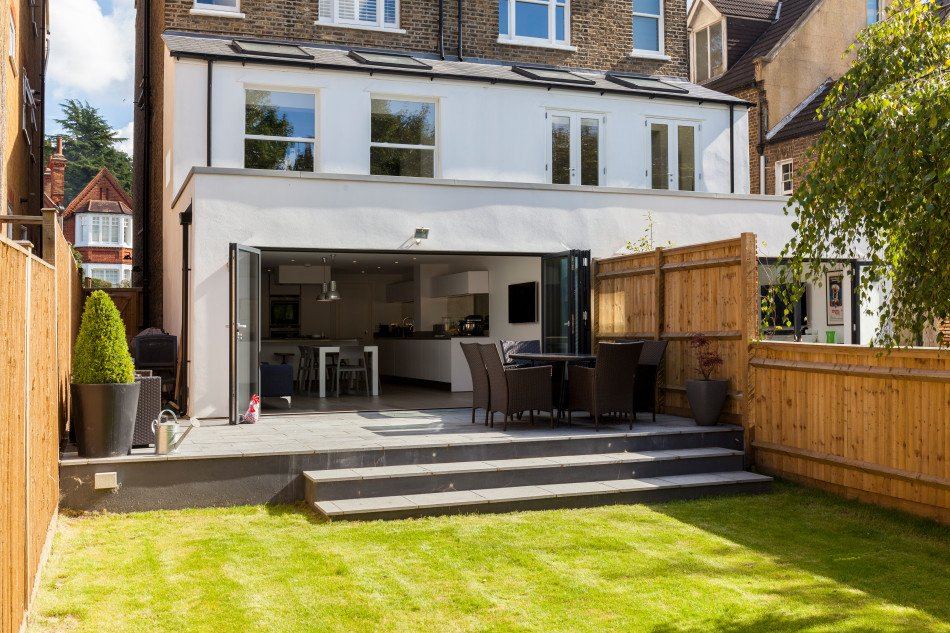
A modular extension is a house extension built using a mix of off-site manufacturing and on-site assembly. The structural frame and panels are manufactured in a factory under controlled conditions, arrive as flat-packed components — walls, roof sections, insulation, floor cassettes — and are hand-assembled by a small on-site team over several weeks.
It's worth being precise here, because 'modular extension' can mean two quite different things. Some companies build fully volumetric modules — complete room boxes assembled in a factory and craned into position on site. That approach works, but it carries real drawbacks: it needs crane access and heavy plant, rules out tight or awkward sites entirely, requires road closures and large deliveries, and limits design flexibility to what can be transported as a finished box.
A Vita Modular extension is different. Ours is a hybrid, panelised system: the structural steel frame and insulated panels are precision-made off-site, then delivered flat and hand-assembled on site — with no cranes and no heavy plant. This hybrid approach is deliberately designed to bridge the gap between Modern Methods of Construction (MMC) and traditional building — you get the factory precision, speed, quality control and airtightness of MMC, combined with the on-site adaptability and site access of a traditional build. It's the best of both, without the crane. Vita designs, manufactures and installs these extensions across the UK from a facility in Coventry.
The short answer. The structural frame and panels are made in a factory, then delivered and hand-assembled on site — no cranes, no heavy plant. Extensions start from £34,000 inc. VAT for a complete, weathertight, decorated shell, priced at £3,000/m² for ground-floor work and £2,750/m² for a first floor added above (which includes the pitched roof and scaffolding). Kitchen and bathroom are not in the base rate — they're itemised options.

From first enquiry to handover, the process runs in a predictable sequence — most of the disruptive work happening in the factory, not your garden.
Yes and no. 'Prefab' historically meant fully volumetric construction — the complete craned-in room boxes described above, which exclude any home without crane access. Vita Modular's system is panelised: the structural components are prefabricated off-site, then hand-assembled on site. The manufacturing benefits are the same; the site-access limitations are not.
In everyday search 'modular', 'prefab' and 'prefabricated' extension are used interchangeably — Vita ranks for all three — but the product is more accurately a panelised modular system.

The most common configuration — extending a kitchen into an open-plan kitchen-diner or adding a reception room. From 15m² (from £45,000).
Floor area on both levels — typically a bedroom and en-suite above a new kitchen. A 40m² two-storey is £117,750, and the best cost per m² for larger additions.
Adds a new storey in the airspace above your existing ground floor — a first-floor bedroom, en-suite or study built over what's already there, without extending the footprint. Priced at £2,750/m² on the same shell basis, with the pitched roof and scaffolding included in that rate. Ideal where garden space is limited but there's room to build upwards.
Infills the narrow side alley of a Victorian terrace. Popular in London, Birmingham and Bristol — and well suited to Vita's no-crane system, where many crane-lifted competitors cannot build side returns at all.
Combines rear and side into an L-shape. A 21m² wraparound is £63,000. Usually requires full planning permission.
Many qualify as permitted development — the criteria are the same as any house extension: size, height, proximity to boundaries, and whether the property is listed or in a conservation area. Vita manages the application for you where one is required; architectural, planning and building-control fees are quoted separately at fixed prices.
The shell is priced at approximately £3,000/m² for ground-floor and single-storey work, and £2,750/m² for a first floor added above (a rate that includes the pitched roof and scaffolding), inclusive of VAT — single-storey from £45,000 (15m²), two-storey from £117,750 (40m²). Kitchen, bathroom and wider glazing are itemised options, never part of the base rate. Full pricing breakdown with worked examples →
Yes. Built on a structural steel frame, meeting UK Building Regulations, covered by a 10-year structural warranty — permanent additions to your property, mortgageable, insurable, and adding measurable market value.